




Contents
- What cortisol means over the course of the day
- Sleep routine: the basis for a reliable rhythm
- Exercise and breaks: dose strain instead of bundling everything together
- Nutrition: a steady everyday routine instead of a perfect plan
- When a cortisol saliva test may be useful
- Before the test: frequent questions and typical mistakes
- Your next step
- Frequently asked questions
The cortisol level describes how much cortisol is available in the body at a particular point in time. Cortisol is a central hormone in stress regulation and plays an important role in energy balance, daily rhythm and adaptation to strain, among other things. For everyday life, this means: sleep times, exercise, breaks, meals and caffeine habits can be connected with how resilient you feel. If persistent stress, exhaustion, sleep problems or inner restlessness are present, a cortisol saliva test can provide additional orientation.
What cortisol means over the course of the day
Cortisol is often referred to as a stress hormone. That is not wrong, but it is shortened: cortisol is not only active in stressful situations, but is part of a normal daily rhythm. Therefore, a single value without the time of day, symptoms and lifestyle is only of limited significance.
Many people only pay attention to cortisol when everyday life is permanently tightly scheduled: early appointments, few breaks, a lot of screen time, late meals, coffee in the afternoon and organisational tasks in the evening. This often creates the feeling of being “on” all day and still not really getting into recovery.
It is important: a cortisol value is not a label for “too stressed” or “not resilient”. It is a laboratory indication that should be interpreted together with the time of day, sleep, symptoms, nutrition, exercise and your current life situation.
Sleep routine: the basis for a reliable rhythm
A regular sleep-wake rhythm is a practical point of orientation in everyday life. What matters is less the perfect time and more repetition: bedtimes and wake-up times that are as similar as possible, and not completely shifted even at the weekend.
An evening that works in everyday life might look like this, for example: the last large meal two to three hours before going to bed, dim the lights one hour beforehand, charge the mobile phone outside the bed and write down the next tasks for tomorrow. This means the mind does not have to keep planning in bed.
Typical mistakes are very late intensive sports sessions, working right up until bedtime, large amounts of alcohol in the evening or “catch-up sleep” well into the late morning. If shift work, young children or care responsibilities make fixed routines difficult, a smaller goal is worthwhile: a fixed wake-up time on most days and a short evening ritual of 10 minutes.
Exercise and breaks: dose strain instead of bundling everything together
Exercise does not have to be maximally strenuous to have a place in everyday life. A combination of regular walking, moderate activity and strength stimuli is useful. For many working people, getting started is easier if exercise is not used as an extra appointment, but as a structure.
- In the morning: 10 minutes of daylight and walking, for example getting off one stop earlier.
- At lunchtime: a 15- to 20-minute walk after eating, without a phone call.
- 2 to 3 times per week: 20 to 30 minutes of strength exercises, such as squats, rowing with a band, wall push-ups and lunges.
- When under high strain: it is better to train moderately and regularly than rarely and very intensively.
Breaks are also not only useful once you are completely exhausted. A practicable pattern is 50 minutes of focused work followed by a 5-minute interruption: stand up, get water, look out of the window, move your shoulders. These short changes fit particularly well if your working day is strongly characterised by screens, sitting time and deadline pressure.
Nutrition: a steady everyday routine instead of a perfect plan
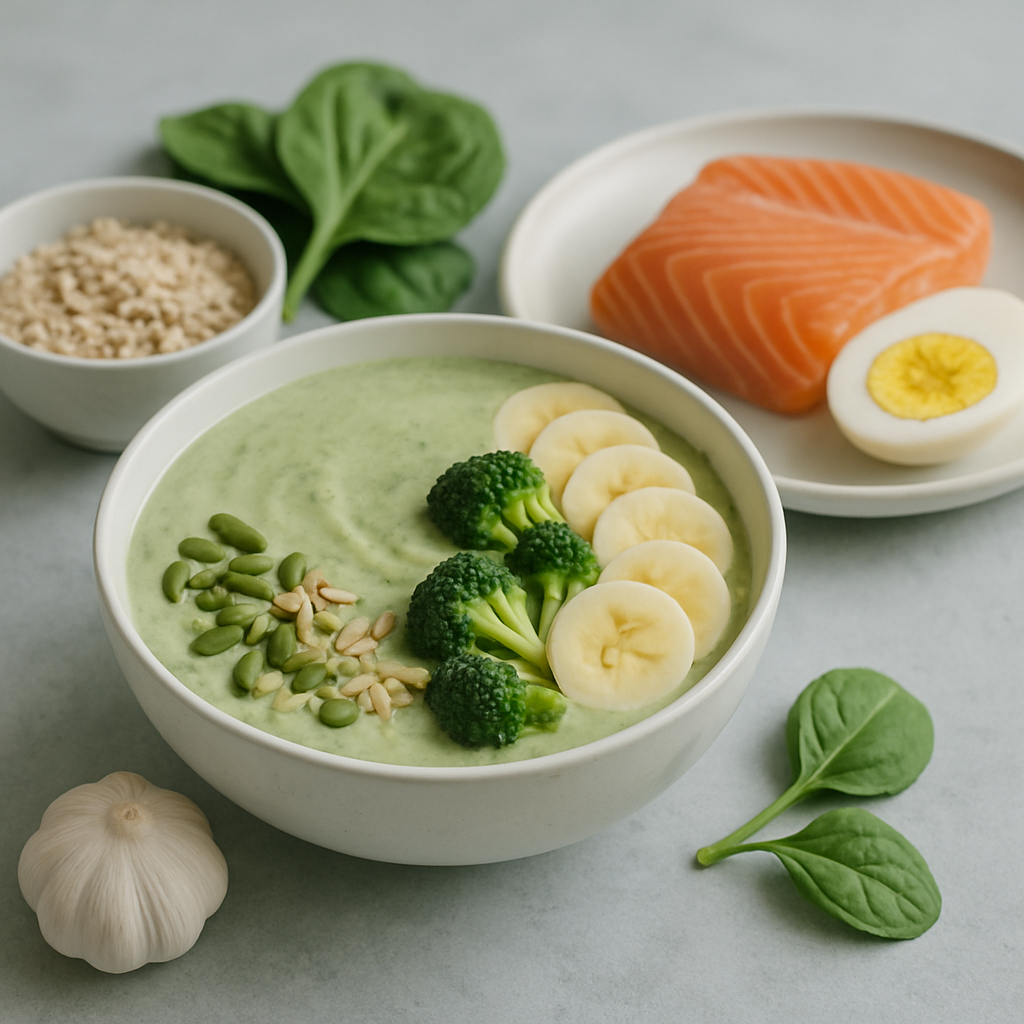
Nutrition around stress often does not begin with special foods, but with rhythm. Anyone who only drinks coffee in the morning, eats something sweet on the side at lunchtime and makes up for it with very large portions in the evening often experiences clear differences in their sense of energy. A stable daily routine is easier with plannable meals.
Examples of simple meals
- Breakfast: 200 g natural yoghurt or skyr, 40 g oat flakes, 1 handful of berries, 1 tbsp nuts or seeds.
- Savoury in the morning: 2 eggs or 150 g tofu, 1 slice of wholemeal bread, tomatoes, cucumber and a little olive oil.
- Lunch: 1 plate with ½ vegetables, ¼ protein source such as lentils, fish, egg, chicken or tempeh and ¼ potatoes, wholegrain rice or quinoa.
- Snack: 1 apple with 1 tbsp nut butter, vegetable sticks with hummus or a small handful of nuts.
- Dinner: vegetable stir-fry with 150 to 200 g pulses, tofu, fish or lean meat plus herb quark or yoghurt dip.
Caffeine deserves particular attention. Many people tolerate coffee well in the morning, but react sensitively to later amounts. A practical test in everyday life: plan coffee and strong black or green tea only until midday for two weeks and switch to water, herbal tea or decaffeinated options from 2 p.m.
Drinking too little can also make the day unnecessarily difficult. As a simple guide, you can place a bottle of water somewhere visible in the morning and drink it by early afternoon. With heavy sweating, sport or warm weather, the need increases individually.
When a cortisol saliva test may be useful
A saliva test can be of interest if symptoms and everyday situation do not match or if you would like to classify your strain situation more precisely. The Medivere Speicheltest Cortisol is used to determine the cortisol level in saliva. Sample collection is non-invasive and designed for use at home.
The test can be particularly useful if persistent stress, exhaustion, tiredness, sleep problems, inner restlessness or the suspicion of disturbed stress regulation are present. It is important not to consider the value in isolation. The assessment should always be made in connection with the time of day, symptoms and further diagnostic information.
If DHEA is also to be considered alongside cortisol, the Medivere Stressprofil – Cortisol & DHEA Speicheltest may be an option. It is a laboratory-based examination for assessing stress-related regulation patterns and can be a useful basis for further counselling.
Laboratory tests provide indications and do not replace a medical diagnosis. If results are abnormal, symptoms are severe, there is a sudden deterioration or exhaustion persists for a longer period, you should consult a doctor.
Before the test: frequent questions and typical mistakes
Is a self-test enough? A laboratory value is always only one part of the picture. Note down your sleep times, caffeine, exercise, particular strains and meals in advance for seven days. This information makes the later interpretation significantly more meaningful.
When should the sample be taken? Follow the instructions for the respective test exactly. With cortisol in particular, the time of day is important because the value can vary over the course of the day.
What distorts the interpretation? Frequent mistakes are incomplete information on the time of day, samples on unusual days, major deviations from the usual routine or an evaluation without looking at sleep, work situation and symptoms.
Which other topics may be relevant? If tiredness despite sufficient sleep duration is the main issue, you will find additional classification in the article Constant tiredness despite sleep – when metabolism may play a role. If you are specifically interested in DHEA in the context of saliva tests, the article Stress management through DHEA saliva testing may be a suitable addition.
Your next step
Frequently asked questions
What does your cortisol level over the course of the day mean for you?
The cortisol level describes how much cortisol is available in the body at a particular point in time. Cortisol is part of a normal daily rhythm, so a single value without the time of day, symptoms and lifestyle is only of limited significance.
When can a cortisol saliva test be useful for you?
A cortisol saliva test can provide additional orientation if persistent stress, exhaustion, sleep problems or inner restlessness are present. The value should not be considered in isolation, but in connection with the time of day, symptoms and further diagnostic information.
How can you structure your everyday life around cortisol?
Sleep times, exercise, breaks, meals and caffeine habits can be connected with how resilient you feel. Regular sleep-wake times, moderate exercise, short breaks during the working day and plannable meals provide practical orientation.
If you would like to have your cortisol level, your everyday routines and possible laboratory values classified in a structured way, we will be happy to support you at the Zentrum für Prävention und Ernährung in Berlin. Together with nutritional consultant Olha Bezuhla, you can clarify which steps fit your everyday life and whether a saliva test is useful: Request counselling.
This article is for general information and does not replace medical advice, diagnosis or treatment.
{“@context”:”https://schema.org”,”@graph”:[{“@type”:”FAQPage”,”mainEntity”:[{“@type”:”Question”,”name”:”What does your cortisol level over the course of the day mean for you?”,”acceptedAnswer”:{“@type”:”Answer”,”text”:”The cortisol level describes how much cortisol is available in the body at a particular point in time. Cortisol is part of a normal daily rhythm, so a single value without the time of day, symptoms and lifestyle is only of limited significance.”}},{“@type”:”Question”,”name”:”When can a cortisol saliva test be useful for you?”,”acceptedAnswer”:{“@type”:”Answer”,”text”:”A cortisol saliva test can provide additional orientation if persistent stress, exhaustion, sleep problems or inner restlessness are present. The value should not be considered in isolation, but in connection with the time of day, symptoms and further diagnostic information.”}},{“@type”:”Question”,”name”:”How can you structure your everyday life around cortisol?”,”acceptedAnswer”:{“@type”:”Answer”,”text”:”Sleep times, exercise, breaks, meals and caffeine habits can be connected with how resilient you feel. Regular sleep-wake times, moderate exercise, short breaks during the working day and plannable meals provide practical orientation.”}}]}]}
This article is for general information only and does not replace medical advice or treatment.

Nutrition scientist (postdoctoral research, Potsdam)